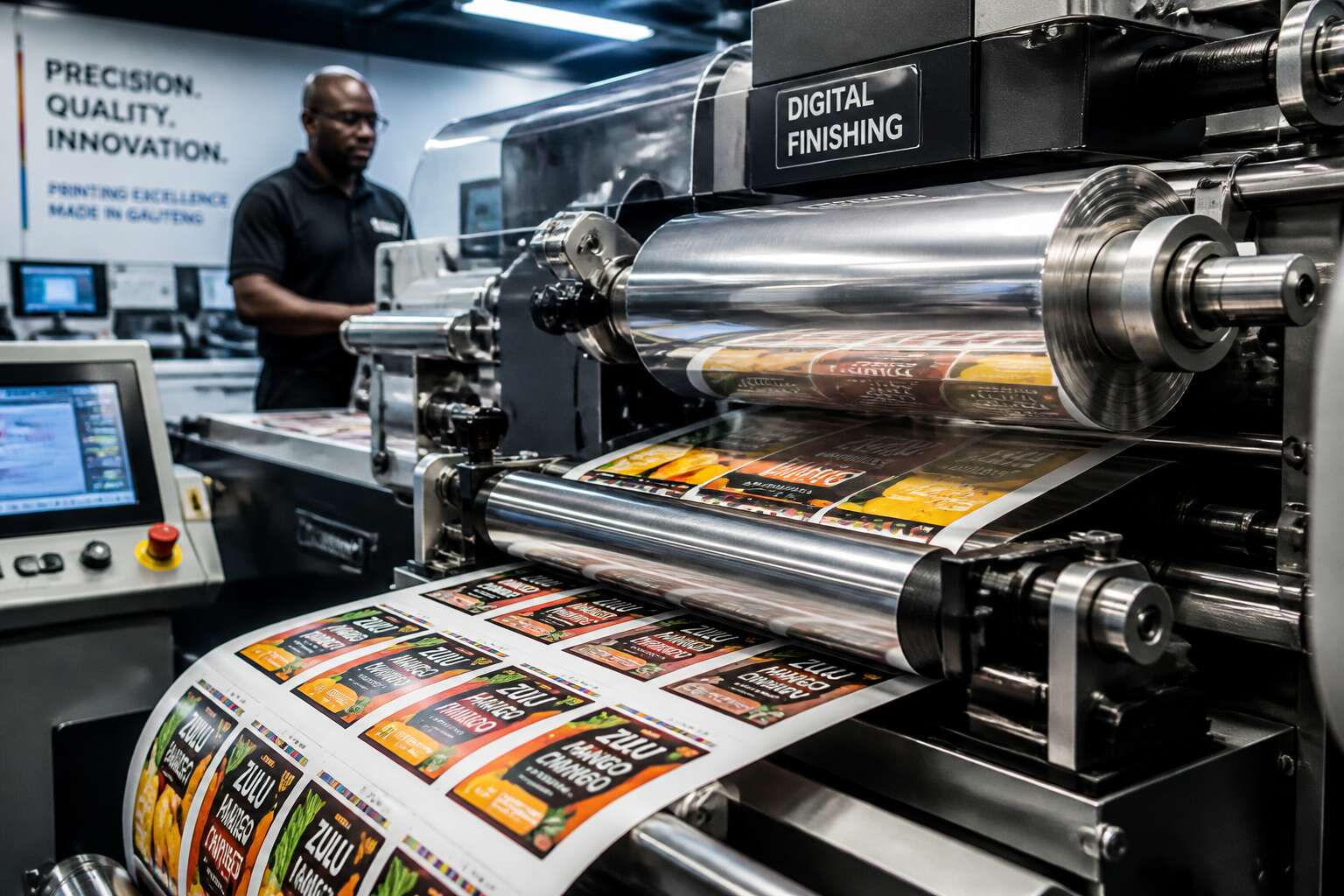
The Role of Finishing in Digital Label Production
Why Finishing Matters for Digital Output
Finishing transforms raw digital prints into labels that survive contact with oils, friction, and production lines. Without lamination or varnishing, even premium inks fade or scuff. A digital label finisher gauteng provides these critical steps in one streamlined pass.
Why does this matter for digital output? Unlike conventional presses, digital devices produce variable data jobs and shorter runs. That means finishing must keep pace without sacrificing consistency. Consider what a finisher actually handles:
- Lamination and spot varnish for resistance
- Rotary die cutting for precise contours
- Waste stripping for clean matrix removal
Each step affects adhesion, legibility, and durability. A label that peels or smudges undermines the entire brand, regardless of print quality. Finishing is where production reality meets design intent.
Core Label Finishing Processes Explained
Finishing is the point where digital print becomes a physical product. A digital label finisher gauteng sequences slitting, rewinding, and inspection into one continuous flow. That matters because a single flawed roll can halt an entire packaging line!
The core processes follow a strict sequence. Cold foil adds metallic detail without heavy tooling costs. Embossing creates tactile depth that signals premium quality. Slitting produces consistent roll widths for smooth conversion. Barcode verification confirms readability before dispatch.
Each function demands precise registration. A misaligned label disrupts downstream applicators, and ink adhesion weakens under environmental stress. We catch these failures here, not after distribution.
Common Challenges of Finishing Short-Run Digital Labels
Every digital label carries hidden vulnerabilities. The toner or ink sits on the surface, vulnerable until a digital label finisher gauteng applies the right combination of heat, pressure, and lamination. Without this intervention, the printed image remains merely decorative. It cannot withstand friction, moisture, or the abrasion of high-speed packaging machinery.
Short-run digital labels introduce their own complications. Each batch may differ in substrate thickness, adhesive strength, or surface energy. A finisher must compensate for these variations in real time. Calibration drift, static cling, and web tension fluctuations all threaten consistency.
Consider what the finisher manages!
- Register accuracy across variable print runs
- Lamination adhesion on low-surface-energy films
- Waste reduction when setup consumes more material than the job itself
These variables demand precision over brute force. I have watched a digital label finisher gauteng turn a flawless roll into costly rejects within minutes. The difference is adaptation.
Key Capabilities to Look For in a Finishing Partner
Precision Die-Cutting and Registration Accuracy
Nobody calls their die cutter to boast about mediocre registration. Yet many shops accept hairline misalignment as a lifestyle choice. When you evaluate a digital label finisher gauteng, precision die cutting and registration accuracy separate the dependable operators from the rest. You need a machine that reads registration marks every single revolution, not just on Tuesdays.
Look for these non-negotiable abilities in your finisher:
- Servo driven web tension that holds label dimensions constant
- Vision systems that catch drift before it creates scrap
- Die cutting tolerances measured in microns
Registration accuracy also demands a rigid frame and tooling with stable geometry. A flimsy unit will drift enough to ruin a batch.
laminating, Spot UV and Foiling Options
A finishing partner’s real skill shows in how they handle the tactile details. Laminating, spot UV, and foiling each serve a distinct purpose, yet many converters treat them as interchangeable extras. A laminate layer protects the ink from abrasion and moisture, while spot UV adds a tactile contrast that catches the eye without covering the whole label. Foil creates a metallic reflection that no printed silver ink can replicate.
When you evaluate a digital label finisher gauteng, ask how these processes are applied. The best partners run them in-line or with minimal handling, because every rewind introduces a chance for scratches, dust, or misalignment. Also consider the substrate’s behaviour: a stiff foil needs different tension than a soft laminate, and a capable digital label finisher gauteng knows the difference.
Look for a partner who offers:
- gloss and matte laminates in various thicknesses
- spot UV with precision registration to the printed artwork
- hot and cold foil options for different run sizes
Inline vs Offline Finishing Workflows
When you inspect a finishing partner’s setup, the first question is whether they run inline or offline. Inline finishing keeps the job moving from press to finisher without stopping, which suits short runs that need same-day delivery. Offline finishing allows the team to schedule each process separately, offering flexibility for complex jobs that require multiple passes.
A competent digital label finisher gauteng will tell you honestly which workflow suits your job. They should also show you their quality control checkpoints, not just their machines. I have seen well equipped facilities produce average work because the operators lacked the patience to inspect each reel thoroughly.
Look for these capabilities when you compare a digital label finisher gauteng:
- Automated inspection systems that flag defects while the machine is still running
- Clean, climate controlled environments that reduce static and dust
- Backup equipment for critical processes, so a breakdown does not halt your order
Handling Variable Data and Fast Turnaround Times
When we audit a potential digital label finisher gauteng, the first thing we check is how they handle variable data. A single misprinted barcode can ground an entire product shipment. The finisher must run verification systems that read every code before the reel advances. Most operations fail here because they spot check one sample and assume the rest matched. That assumption gets costly.
Fast turnaround times demand a different discipline. The finisher should stage jobs before the press stops, with die positions and blade depths programmed in advance. Ask about their queue management software and how they sequence rush orders without disrupting quality checks.
Key capabilities to confirm:
- Inline vision systems that capture and verify every single label
- Dedicated operators tasked solely with variable data inspection
- Backup finishing lines that cover critical deadlines during breakdowns
A digital label finisher gauteng with these systems can turn a morning proof into a shipped reel by afternoon. The difference shows in your rejection rate.
Technology and Equipment Considerations for Local Producers
Rotary Cutters vs Laser Die-Cutting Systems
Rotary cutters and laser die-cutting systems serve different production realities. A rotary cutter stamps shapes using steel dies wrapped around a cylinder, which rewards high volume with speed and consistency. Laser systems cut with focused light, removing tooling costs and allowing instant geometry changes between orders.
For a digital label finisher gauteng, the choice hinges on the job queue. Repeat work for established brands justifies the die investment, while exploratory clients benefit from the laser’s shape flexibility. Many shops run both technologies, assigning volume to rotary and short-run prototyping to laser.
The real difference emerges in maintenance: rotary dies wear and require sharpening, while laser optics need calibration and dust control. A digital label finisher gauteng must weigh these operational realities against typical order sizes.
Modular and Hybrid Finishing Lines
Finishing lines in Gauteng have shifted from permanent installations to adaptable configurations. Modular systems let producers swap modules as order volumes change. A digital label finisher gauteng might run sheeting today and lamination tomorrow, simply by changing the line setup.
Hybrid lines combine digital print engines with traditional finishing units. This arrangement suits converters who handle short runs and rapid changeovers. Capital outlay stays proportional to actual production needs, which matters for shops entering the digital space.
A digital label finisher gauteng requires modules that communicate with existing prepress software. Each module adds technical complexity.
- Rewinders for roll to roll work
- Sheeters for flat label stacks
- Inspection systems for quality control
Independent serviceability keeps uptime predictable and prevents a single failure from halting the entire operation.
Inspection Systems and Automated Quality Control
The human eye misses a great deal after hour three on a running line. Automated inspection systems catch what we cannot. For a digital label finisher gauteng, these units scan for hickeys, registration drift, and coating skips in real time. Cameras feed data back to the operator, flagging faults before they become costly waste. This matters for local producers who serve the food and beverage sector, where barcode scannability is non-negotiable. Consider what a modern inspection suite typically includes:
- High resolution line scan cameras for narrow web work
- Stroboscopic lighting to freeze motion
- Defect classification software that sorts repairable from fatal flaws
- Automatic marking or waste diversion triggers
Each component talks to the central control system. The result is a smoother workflow and fewer complaints from retailers down the line, which keeps repeat work coming back to your floor.
Finishing for Specialty and Eco-Friendly Substrates
When local producers switch to sugarcane-based film or recycled PET, the finishing line demands different hardware. A digital label finisher gauteng must adjust nip pressure, web tension, and curing temperature for each substrate. Compostable films often deform under standard UV lamps, while textured papers wear out steel cutting dies faster. The following equipment adjustments matter:
- Ceramic anvils to handle abrasive recycled facestocks
- Heated rollers for shrink films that need controlled tension
- Low-energy UV systems that cure without warping heat-sensitive surfaces
Eco-friendly inks and varnishes also interact with corona treatment. A finisher with variable corona power ensures adhesion across batch variations. The right setup turns fragile materials into reliable labels, reducing waste and rework. For a digital label finisher gauteng, these considerations lower rejected rolls and keep brand owners satisfied.
Scalability Options for Growing Label Volumes
Most Gauteng label converters add capacity in bursts, not curves. A digital label finisher gauteng can handle 5,000 labels today and 50,000 next quarter, but only when the line grows with you.
Consider these scalability signals:
– Servo-driven modules that accept retrofits without rewiring
– Quick-change cassettes for different label widths
– Software that tracks job counts and predicts wear on consumables
The real bottleneck is rarely speed. It is the ability to add a lamination station or a second rewinder without stopping production. Local producers should demand open architecture from their digital label finisher gauteng. That means standard interfaces, spare parts availability in Johannesburg, and training support beyond the installation week. As volumes climb, finishing redundancy matters more than raw throughput. A second, smaller finisher dedicated to proofs and micro-runs protects your main line for commercial jobs.
Navigating the Label Finishing Market in Gauteng
Demand Drivers Across Johannesburg, Pretoria and Surrounding Hubs
Johannesburg’s factories run on speed. Pretoria’s pharmaceutical and chemical plants, by contrast, prioritise lot traceability above all else. The corridors between them, from Midrand to Kempton Park, host logistics firms whose labels must survive cold storage and rough handling. A digital label finisher gauteng operation needs to serve these divergent demands simultaneously.
The region’s craft beverage sector adds another pressure point. Smaller brewers in Centurion and artisan food producers in the East Rand need short runs that change weekly, while national retailers impose strict compliance standards. This creates a market where flexibility and certification must coexist.
Specific drivers shape this landscape:
- township economy brands scaling up to retail shelves
- export houses requiring GS1-compliant labels
- fast-moving promotional cycles in the FMCG sector
Realistic Lead Times and Cost Expectations
Three weeks is the average lead time for a digital label finisher gauteng operation, but that number hides a spectrum. A rush job in Kempton Park might take 48 hours if the finisher runs a night shift. The cost difference between standard and express finishing can be 40% or more, especially when die-cutting tools need to be remade.
Quoting with a digital label finisher gauteng provider requires understanding their current capacity. Small print shops often outsource finishing, adding two to three days to every order. Direct finishers with inline systems compress that to a single handoff, but they charge for the convenience.
- Tooling reuse is the biggest cost lever. Standard shapes reduce setup fees.
- Substrate availability shifts prices. Specialty films from local distributors cost 15% more than imported rolls.
- Certification checks add hours, not days, if the finisher has automated inspection.
Realistic expectations begin with asking about job queues. A finisher running three shifts has different pricing than one with a single machine. The market in Gauteng spans both. Knowing which you’re dealing with prevents the common shock of a quote that arrives after the deadline.
Evaluating Technical Support, Training and Spare Parts Access
Navigating the label finishing market in Gauteng requires looking past the machine specifications. Technical support separates a smooth operation from a costly one. A digital label finisher gauteng supplier with a local service team can respond within hours, while those relying on international technicians might leave you waiting days.
Training matters just as much. Operators need hands-on instruction for die-cutting and lamination settings, not just a quick demo. Some suppliers bundle training into the purchase price, others charge per session.
Spare parts access is the quiet factor that determines uptime:
- Verify which components are stocked locally in Johannesburg or Pretoria
- Confirm the response time for emergency part deliveries
- Ask if the finisher uses proprietary parts or standard off-the-shelf components
These details turn a good machine purchase into a dependable production line!
High-Demand Label Applications and End-Use Sectors
Food and Beverage Label Finishing Requirements
Cold, wet, and handled constantly. The food and beverage label faces more physical stress than any other packaging piece in Gauteng, which is why finishing requirements here are unforgiving. A digital label finisher gauteng specialist observes this tension in every brief: the craft gin that sits in an ice bucket, the spice packet that gets oil splashes, the juice bottle that sweats in a delivery van.
These labels need barriers, not decoration. The standard requirements demand:
- Water-resistant laminates for chilled products
- Scuff-proof coatings for high-touch retail packaging
- Compliant variable data for batch and expiry tracking
Finishing equipment must handle these without slowing down short runs. Food and beverage producers across the region increasingly expect a digital label finisher gauteng to deliver these finishes inline, while keeping costs per label viable.
Cosmetics and Personal Care Labels with Premium Effects
Cosmetics live on shelf presence. Beauty shoppers in Johannesburg and Pretoria make purchase decisions in seconds, and the label often decides the sale. Where food packaging demands rugged barriers, personal care labels ask for a sensory promise sealed in print.
A digital label finisher gauteng brings precision to these luxury briefs. The same equipment that runs high-volume beverage labels now applies delicate effects to cosmetic packaging. Brands request fine textures, metallic resonance, and velvet-touch surfaces that signal product quality before the cap is twisted.
Common premium effects requested by personal care brands include:
- Micro-embossed patterns on cream pots
- High-gloss spot finishes on serum bottles
- Frosted matte coatings for minimalist skincare lines
Each finish must survive bathroom humidity and daily handling without breaking short-run economics. For every boutique beauty launch, a digital label finisher gauteng must match the brand’s obsession with detail.
Pharmaceutical Labels: Durability and Compliance
Pharmaceutical labels face harsh environments. They endure cooling chains, alcohol swabs, and sticky fingers in clinic waiting rooms. Yet every batch must remain readable to the second language of regulators. The digital label finisher gauteng steps in to harden that promise.
Finishing here prioritizes durability over decoration. A poorly cured lamination can delaminate under heat. A weak adhesive can curl at the edges before the vial reaches a pharmacy shelf.
- Solvent-resistant over-lamination for intravenous bags
- Scratch-proof matte varnishes for unit-dose packaging
- Conformable films for curved ampoule necks
Each pass through the digital label finisher gauteng must keep barcodes scannable through every environmental stress test. The result is a label that quietly meets the law without drawing attention.
Wine and Craft Beverage Labels
A wine label does not name a vintage alone. It carries the weight of a terroir, the patience of a cellar, and the memory of a long summer afternoon. In Gauteng, bottles travel from cold storage to braai tables, from ice buckets to perspiring hands. Condensation beads on the glass. Labels must not curl at the edges. The digital label finisher gauteng becomes the quiet custodian of that promise.
- Soft-touch lamination for a velvety grip
- Deep embossing that mimics a winery’s crest
- Metallic foil that catches candlelight at a tasting room
Each finish must survive the journey from Paarl to Pretoria without smudging or fading. The digital label finisher gauteng ensures a craft brewer’s punchy can art or a small vineyard’s hand-drawn sketch stays as crisp as the day it left the press.
Industrial and Logistics Labels for Harsh Environments
An oil drum sitting in a Witbank yard takes a beating. Forty degrees in the shade, diesel mist, rain, then dust. The label on that drum has one job: stay readable. A digital label finisher gauteng applies a tough overlaminate that resists solvents and abrasion, keeping barcodes scannable for months.
Warehouses and logistics hubs demand more than pretty print. Labels that track returnable crates, cable reels, and heavy machinery parts must handle rough conditions. They need:
- Rub resistance against repeated handling
- Chemical resistance to oils and cleaning agents
- Adhesion on curved, textured, or powder-coated surfaces
In Gauteng’s distribution network, a faded label halts a shipment. The digital label finisher gauteng is what keeps cargo moving through the system without a second thought.
Security and Tamper-Evident Label Finishing
Counterfeit goods cost South African manufacturers millions each year. A label alone cannot stop them, but the right finishing can make tampering obvious. A digital label finisher gauteng applies void adhesives that leave a clear message when someone tries to peel the label. The transfer leaves behind a checkerboard pattern or text, showing the package has been opened. Peel one off yourself and the result is unmistakable!
Security options now go beyond simple adhesives:
- Destructible face stocks that tear on removal
- Security slits that break the label into unreadable fragments
- Holographic foils that are difficult to source or replicate
- Serrated edges that make clean removal impossible
These finishing choices work well on pharmaceutical cartons, electronics, and high-value components moving through Gauteng warehouses. The digital label finisher gauteng can also add variable serial numbers and barcodes beneath a tamper band, so inspectors know instantly if a unit has been compromised. That is the difference between a label that identifies a product and one that protects it.
Operational Best Practices for Finishing Efficiency
Integrating Finishing Workflows with Digital Printers
Those quiet minutes between press and finisher often decide whether a Gauteng label job makes money. Operators who treat the finisher as an extension of the digital press, rather than a separate step, remove most of that dead time.
Standardising setup routines changes everything. When every operator reads the same registration marks and sensor offsets, changeovers stop being unpredictable. Common practices in well-run shops include:
- grouping jobs by substrate width to reduce adjustment steps
- loading job tickets into the finisher’s controller before the first roll arrives
- scheduling maintenance windows around digital press load forecasts
The integration matters most when variable data moves from printer to finisher. A digital label finisher gauteng that receives the same file structure each time lets operators trust the machine’s decisions. That trust becomes speed.
Material Storage and Substrate Handling Strategies
Substrate storage is where finishing efficiency begins. Gauteng’s dry winters and humid summers create dimensional shifts in label stock. A digital label finisher gauteng operator who ignores this pays for it in registration errors on the die-cutting station.
Rolls sit upright, away from direct sunlight, and materials acclimatise to the finishing room for at least 24 hours before running. Batch numbers and expiry dates stay logged for traceability. That log becomes the first reference when a job behaves unexpectedly.
- Consistent temperature around 23 degrees Celsius
- Humidity held between 45 and 55 percent
- First-in, first-out rotation of stock
Clean handling prevents debris from reaching the cutting station. Dedicated trolleys and protective end caps preserve roll integrity through the workflow. For any digital label finisher gauteng, these habits turn material variance into predictable output, and predictable output is what keeps short-run pricing viable.
Maintaining Color Consistency and Print-to-Finish Quality
Colour drift costs South African label converters roughly 15 percent of their rework budget. A digital label finisher gauteng operator cannot rely on the printer alone; the finishing line must carry its own colour discipline.
Calibrate spectrophotometers at shift start. Verify ink density against the approved proof before every run. The substrate, the lamination film, even the anilox roller condition alter perceived colour. One operator, one standard reference, one logbook. This removes guesswork from the finishing floor.
- Measure colour at the unwind station and again after lamination
- Compare delta E values against the signed proof
- Record every reading with the job number
For a digital label finisher gauteng, this routine converts subjective judgement into repeatable output. When the customer inspects a batch, the colour matches the proof, and the rework count stays low.
Staff Training and Preventive Maintenance for Finishing Equipment
A finishing line only runs as fast as its slowest operator. Cross training staff on multiple stations prevents bottlenecks when someone is absent. A digital label finisher gauteng benefits from a quarterly skills matrix review.
Preventive maintenance is a schedule, not a reaction. Lubricate bearings, inspect cutting dies, and replace worn rollers after every shift. Log every task.
Operators should understand failure modes, not just restart procedures. Teach them to recognise bearing noise and tension drift.
- Clean sensors at shift start
- Verify torque settings weekly
- Calibrate tension controls monthly


0 Comments