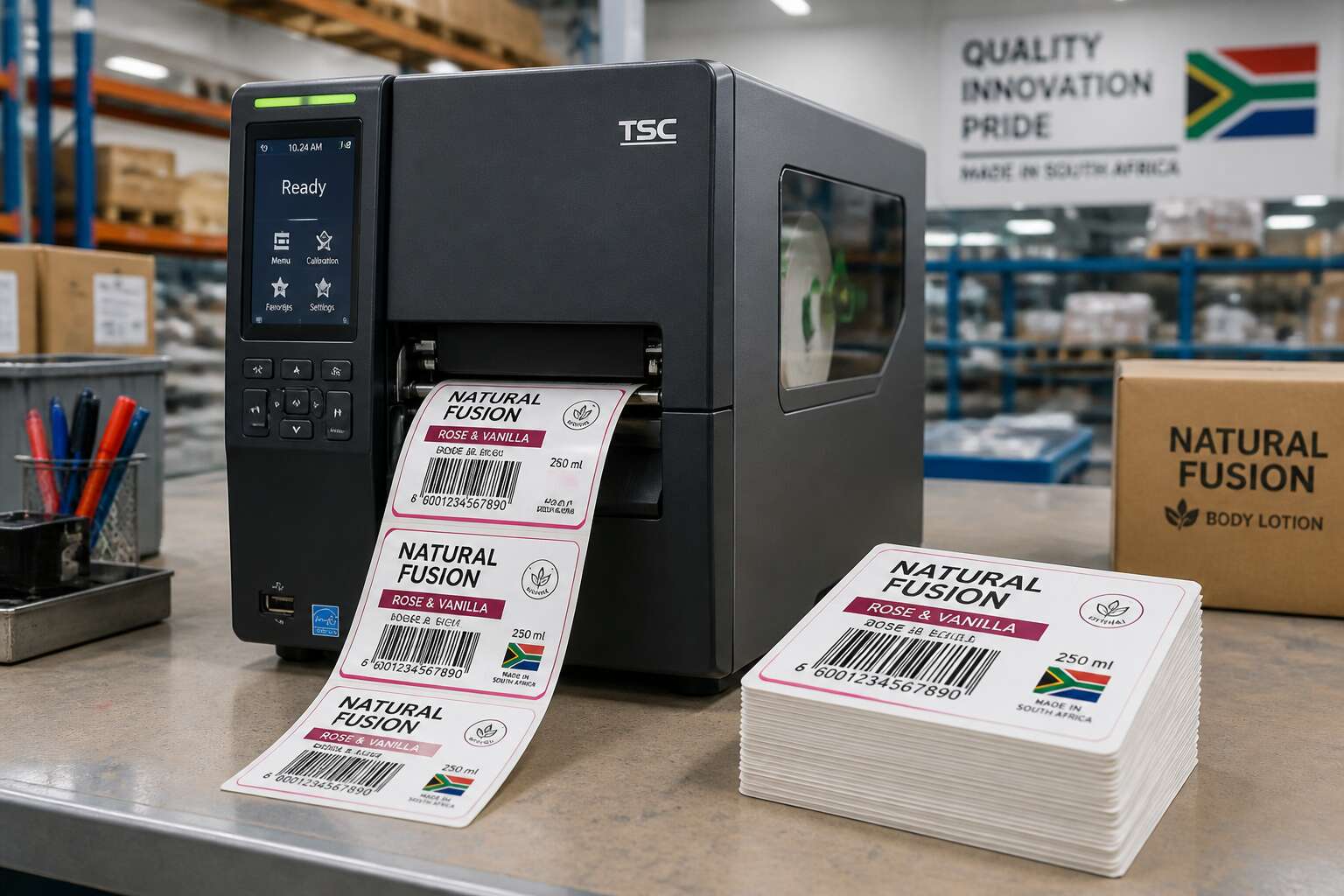
What Are Continuous Label Printers?
Definition and Basics
Every production line in South Africa eventually meets the same demand: labels that never stop arriving. A continuous label printer south africa is built for this. Unlike sheet fed printers, these machines draw from an endless roll. Each label is produced in sequence, cut, and delivered without pause. Label length is set in the software, not fixed by a page size.
What truly separates a continuous label printer south africa from standard office equipment is its stamina. It runs for hours, prints variable barcodes, and tolerates heat, dust, and vibration. Common features include:
- Ribbon saving modes for thermal transfer units.
- Calibrated sensors that maintain consistent label gaps.
- Heavy duty cutter assemblies for high volume output.
These machines are not glamorous. They are relentless, and their output shapes everything from pharmaceutical vials to pallet deliveries.
How They Differ from Batch Printers
Your production line may operate in stops and starts without you realizing it. Batch printers demand constant attention. Someone must load new stock, reset parameters, and monitor each run. This interruption costs time. A continuous label printer south africa eliminates the rhythm of stopping and starting. It feeds from one long roll and prints without a break. There is no fixed quantity per batch and no waiting for a job to end before the next begins.
The operational difference is substantial. Batch printers need scheduled windows for each print job. They suit long runs of identical labels. Continuous printers handle sequence changes mid-run. Variable data, such as serial numbers or dates, changes on the fly. This allows production to flow without pausing for reconfiguration. A continuous label printer south africa is a direct extension of the packing line. Its output is immediate. It keeps pace with filling and sealing equipment. Batch printers often create a bottleneck. They require finished goods to sit in a queue while labels are prepared.
For manufacturers facing high demand, the distinction is between waiting and moving. The continuous model delivers labels as products move. That is its primary value in South African factories.
– Batch printing works for defined jobs with long production runs.
– Continuous printing handles variable lengths and quantities within a single run.
– Continuous models reduce the need for manual intervention and stock management.
The choice depends on the flow of your operation. If your line stops for labels, you have a batch workflow. If labels arrive without pause, you run a continuous process. A continuous label printer south africa suits high volume environments where downtime is expensive. It is not about printing faster. It is about printing at the speed of your line, without forced interruptions. The machinery is designed for that rhythm. The result is a smoother, more reliable shift.
Key Benefits for Businesses
A recent survey across manufacturing hubs in Gauteng and the Western Cape found that 89% of label-related failures stem from human intervention, not machine error. That is a striking figure when you consider how many production lines rely on manual label changes. A continuous label printer south africa shifts that balance. It removes the need for an operator to hover over the equipment, swapping rolls or adjusting plates. The machine simply runs, and the labels are correct.
The real advantage is the reduction of touchpoints. Fewer hands on the system means fewer chances for mislabeling or misalignment. This is especially critical in food and beverage production where traceability is non-negotiable.
Continuous systems also handle the burden of variable data. Whether it is a batch code that changes every hour or a unique barcode applied to every single unit, the printer processes this without a pause. Consider the practical flow:
– Labels are printed as products are sealed, not beforehand.
– Data changes are executed via software, not manual setup.
– Operator time is freed for other tasks, such as quality checks.
For South African businesses operating under load shedding schedules, a continuous label printer south africa offers another quiet benefit. It can be integrated with a buffer system, allowing printing to continue while production faces a brief slowdown. This does not solve the power crisis, but it does mean your label output does not compound the problem. Ultimately, the cost per label drops because waste declines and speed increases, but without sacrificing accuracy. You spend less on rework and more on moving product out the door.
Essential Features to Look For
Print Speed and Throughput
The difference between a profitable shift and a bottleneck often comes down to one number on a spec sheet. In the high-stakes environment of South African manufacturing, that number is the linear metres per minute your operation can sustain. Print speed, however, is a seductive metric. A headline figure of 300 mm/s sounds formidable, but it rarely survives contact with a production floor.
Your real throughput is governed by the variable data rate, ink curing time, and the mechanical handling of the media. A unit that prints fast but jams on heavy stock will cripple your output. The true benchmark for a continuous label printer south africa must factor in the complexity of the artwork and the number of printheads firing simultaneously. Speed without stability is just noise.
Several elements dictate whether you hit those targets consistently:
– The resolution grade (dpi) set for the job, which often slows the engine.
– The dithering and processing algorithm inside the controller for complex barcodes.
– The autopositioning system that corrects feed errors without pausing the run.
In the local market, where humidity and temperature fluctuate wildly across provinces, a machine that lacks thermal management will throttle its own speed to compensate. That is throughput you paid for but will never see. Look for a printer that separates the stated maximum speed from the recommended production speed; the gap between those figures tells you the real story of its endurance. The best units maintain their pace during a 10,000 label run, not just a test strip.
Print Resolution and Quality
A single unreadable barcode can stall a distribution centre in Johannesburg before lunch. Print resolution is the quiet insurance against that chaos. For a continuous label printer south africa, 300 dpi handles most packaging, but pharmaceutical and electronics labels demand 600 dpi for crisp microtext and dense Data Matrix codes. That 600 dpi requirement is non-negotiable in those sectors!
Quality extends beyond the printhead. The ribbon tension system and the platen roller determine whether fine lines stay sharp across a full roll, and thermal management prevents heat distortion from warping the media path altogether.
Evaluate these variables before buying:
- The controller’s edge detection for consistent registration.
- The printhead’s energy calibration across varying label stocks.
- The anti-static system that stops dust from marring the image.
Connectivity Options
Connectivity decides how a continuous label printer south africa performs on your factory floor. USB and Ethernet cover basic setups, but industrial environments often require RS-232, PROFINET, or CANopen to communicate directly with PLCs controlling production lines. Ignoring these protocols creates operational delays.
Wireless connectivity demands scrutiny. Wi-Fi supports handheld scanning and mobile printing across large warehousing spaces, while Bluetooth works for short-range label runs. Cloud-connected printers give remote visibility into consumable levels, printing queues, and maintenance alerts across multiple sites.
- Ethernet for reliable, high-volume data flow
- Serial interfaces for legacy machinery compatibility
- Cloud dashboards for fleet-wide printer oversight
Confirm the unit accepts industry-standard command languages like ZPL, EPL, or ESC/POS, so it integrates with existing enterprise systems without costly middleware. A continuous label printer south africa with poor connectivity slows operations regardless of print speed.
Media Handling and Flexibility
In the rush to compare print heads and processor speeds, the truest measure of a continuous label printer south africa often lies in its media handling. A machine that demands constant babysitting, with finicky label paths and restrictive material tolerances, silently drains productivity. The ability to process a variety of stock without extensive manual adjustment is the quiet engine of an efficient workflow.
You need a printer that accepts a wider range of materials, from standard paper to robust synthetic films and thermal transfer materials. The dimensional flexibility is equally critical. Can it switch from narrow tags to wider labels without a major overhaul? For diverse production runs, consider these capabilities:
– Adjustable media sensors that detect gaps, notches, or holes
– A robust printhead pressure system for varying label thicknesses
– Easy access to the ribbon path for quick media changes
Changeover speed between jobs is a hidden operational cost. A continuous label printer south africa with tool-less loading and intuitive alignment systems reduces downtime during shift changes. Furthermore, pay attention to the rewinder and dispensing options. A well-designed cutter or peeler setup supports integration into automated packaging lines, ensuring the label application never becomes the bottleneck. The details of the material path, from label roll to application point, determine the true flexibility of the operation in our market’s demanding conditions.
Popular Applications Across South African Sectors
Food and Beverage Packaging
In South Africa, the food and beverage sector moves fast. Sauces, spices, and artisanal jams all demand labels that keep up. A continuous label printer south africa makes this possible, churning out rolls of identical labels without the stop-start tantrums of batch machines.
Consider the humble biltong packet. It needs a fresh label every single day, often with new batch numbers, expiry dates, and sometimes a creative spelling of ‘snack’. Continuous systems handle this without breaking a sweat. They also excel at:
– Rotating seasonal flavours like pumpkin spice or chilli mango
– Compliance labels with all the mandatory small print
– Short runs for local farmer’s market specials
Nobody wants a printer that sulks mid-run. This one doesn’t. It just keeps rolling, much like the demand for quality snacks!
Logistics and Distribution
Johannesburg warehouses process thousands of parcels daily. Every parcel needs a correct label, the first time. A continuous label printer south africa delivers this without interruption. It prints shipping labels, barcodes, and tracking codes in one fluid pass.
Sortation systems in Cape Town and Durban run at speed. A mislabeled box causes delays, returns, and unhappy customers. Continuous printing removes the gap between labels. Set it once and let it run.
Common logistics applications include:
– Parcel tracking labels for last mile delivery
– Warehouse bin identifiers for picking zones
– Hazardous material warnings for freight
The printer matches conveyor tempo. No stops, no reprints, no waiting. That is what distribution demands across South Africa.
Retail and Point-of-Sale
The retail floor in South Africa is a theater of shifting prices, and the true work happens in the obscured intervals between displays. When a sale begins in Sandton City, the chaos is immediate. Staff scramble with handheld pricing guns, and the tempo of the aisle becomes a frantic dance of peeling and sticking. This is where the quiet endurance of a continuous label printer south africa becomes the unspoken backbone of the operation. It churns out price tags without hesitation, feeding a constant ribbon of adhesive paper that keeps the tide of promotions moving.
Point-of-sale errors are the ghosts that haunt a store’s ledger. A single incorrect price at the till in a Durban boutique can unravel a customer’s trust. The constant, uninterrupted flow of labels erases the margin for human error. Shelf edge labeling, promotional stickers, and clearance tags all emerge from the same disciplined stream, ready to be deployed before the first shoppers arrive. The process is not glamorous, but it is efficient. It offers a rhythm that allows staff to focus on the interaction, not the inventory.
Beyond the basic price tag, the label feeds the commerce of the season. Consider the promotional cycles that demand immediate response:
– “Special offer” callouts for festive seasonal stock
– Fresh produce origin labels for the premium grocery aisle
– Barcode tags for in-store loyalty program sign-ups
These labels are the silent salespeople. They carry the burden of information, keeping the shelves accurate and the checkout counters flowing. In a high-speed retail environment, the printer must maintain this pace without complaint, producing a stream of identical, precise codes until the job is done. It is a quiet, relentless machine, working in the background while the store hums with the energy of a hundred transactions. When the lights dim in the mall at closing time, the labels are already in place, whispering their data to the scanners of tomorrow.
Pharmaceutical and Healthcare
In the quiet corridors of South African pharmaceutical production, a single mislabeled vial can create a ripple of consequence. The stakes are different here than in a retail aisle; they involve patient safety, regulatory compliance, and the precision of dosage information. A continuous label printer south africa operates with a stillness that belies its importance, generating the intricate patterns of barcodes and batch numbers that govern the flow of medicine from manufacturer to dispensary.
The pharmacy environment demands a particular symphony of order. Lot numbers, expiry dates, and schedule classifications must appear with flawless consistency. When a production run begins in a facility outside Johannesburg, the printer must work in concert with high-speed filling lines, spooling out labels that can withstand the cold of the vaccine cold chain or the humidity of a coastal storeroom. It is the guardian of the audit trail.
Consider the distinct labels that emerge from this disciplined stream:
1. Primary packaging labels for ampoules and vials that require tamper evident materials
2. Secondary carton labels that carry usage instructions and national drug code numbers
3. Ward level medication labels used for patient specific dosing in private hospitals
4. Laboratory specimen labels for pathology samples sent to testing facilities in Cape Town
The printer does not ask why it prints, it only ensures that each label is a perfect duplicate of the last. In this sector, where the cost of error is measured in health outcomes, the quiet hum of the mechanism becomes a promise of diligence. It provides the traceability that allows a pharmacist in Pretoria to verify a product’s provenance in seconds, solidifying the trust that holds the healthcare system together.
How to Select the Ideal Printer for Your Operation
Assessing Your Printing Volume
Before you compare models, you must know your numbers. A business printing two hundred labels per shift has different requirements than one pushing five thousand. The volume you process determines duty cycle, ribbon capacity, and the maintenance schedule you should expect from any investment.
South African operations face seasonal surges that complicate the calculation. A continuous label printer south africa suppliers recommend must handle quiet months and peak periods without compromising registration or adhesive performance.
Assess volume with these factors in mind:
- Average labels per day, week, and month
- Peak output during promotional cycles
- Label size variability, since smaller labels drive higher throughput counts
Understanding these figures prevents overpaying for capacity you will never use, or worse, purchasing a unit that stalls during your busiest week.
Budget Planning and Cost Efficiency
The price tag on a printing unit tells you only half the story. The other half lives in consumables, maintenance, and downtime. A continuous label printer south africa businesses rely on must earn its keep through total cost of ownership, not just the initial invoice.
Start with the variables you can control:
- Thermal transfer ribbon costs per roll
- Printhead lifespan under continuous duty
- Service intervals and local support availability
Budget planning demands the same honesty as volume assessment. A cheaper machine with frequent jams will bleed more from your bottom line than a robust model with a higher upfront price. Seek quotes that include installation, training, and warranty terms. Also consider energy consumption and spare part lead times. The ideal unit matches your financial rhythm as closely as it matches your output. When you calculate cost per label across three years, the right continuous label printer south africa supplier offers becomes clear. Choose based on that number, not the sticker price alone.
Integration with Existing Systems
A printing unit that cannot speak to your current software stack becomes a costly orphan. When selecting a continuous label printer south africa operations rely on, integration goes beyond plugging in a cable. It means matching data streams from your ERP or inventory system to the printer’s firmware without custom middleware draining your IT budget.
Ask about protocol compatibility and whether the printer supports existing label templates. Some units require proprietary drivers, while others emulate common languages like ZPL or EPL. The right choice depends on how your warehouse or production line already routes label requests. Test the printer with your actual system before purchasing, not with a demo file.
- Database connectivity for batch updates
- Trigger points from barcode scanners or scales
- Remote status monitoring for predictive maintenance
Those touchpoints determine whether implementation takes days or months. A continuous label printer south africa suppliers offer may look identical on paper, but field performance varies with your existing network architecture.
Supplier Reputation and Support
No supplier can promise a flawless machine. The difference lies in how they behave when something breaks. I have watched warehouses in Cape Town and Durban choose the cheapest continuous label printer south africa, then wait three weeks for a technician. That downtime erases any savings.
Check the vendor’s local footprint before you sign. Ask for their spare parts inventory and average response time. A reputable supplier will offer a loan unit while yours is repaired. They will also document maintenance schedules. In my experience, the real test is a phone call after hours. If nobody answers, you know exactly where you stand.
Warranty and Maintenance Contracts
According to recent logistics reports, unplanned downtime can cost a mid-sized operation over R15,000 per hour. The warranty and maintenance contract is your financial shield against that silent bleed. A basic warranty covers parts, but it rarely covers the labour, the travel, and the lost production time. You need a contract that guarantees a response time, not a vague promise. Before you commit, have the supplier walk you through the exact terms for the continuous label printer south africa you are eyeing. Ask about what constitutes wear and tear, because printheads are often classified separately. Look for a contract that includes scheduled preventative visits. These visits catch small issues before they become catastrophic. In my view, the most valuable clause is the one that offers a temporary replacement unit during a prolonged repair. That commitment keeps your line moving and your clients satisfied. Negotiate the contract length carefully, and read the exclusions twice. The right agreement transforms a reactive repair process into a proactive partnership.
Top Brands and Where to Buy in South Africa
Leading International Brands Available Locally
For local buyers, the supply side has never been healthier. International brands like Zebra, TSC, and HPRT have a steady presence in South African distribution centres, and the phrase continuous label printer south africa now opens doors to tested equipment in Johannesburg, Cape Town, and Durban.
I have walked through distributor warehouses in Midrand and, honestly, the range took me by surprise. The authorised resellers carry working demonstration models and keep genuine parts, so you can examine a machine before you place it in your operation.
A few practical examples of what sits on local shelves:
- Zebra ZT series for intense production lines
- TSC TX and TTP series for common grocery packaging
- HPRT LP models for demanding health sectors
These brands benefit from a local service infrastructure, which shortens the gap between choosing a unit and using it. That is why many production managers spend their budgets through regional sellers instead of waiting on import timetables.
Authorised Distributors and Retailers
Every continuous label printer south africa purchase flows through one of three distinct channels. Authorised distributors hold manufacturer contracts, manage warranty registration, and stock genuine spare parts. Retailers buy from these distributors and handle the end user relationship. Online merchants offer a third route, often with faster delivery but fewer after sales protections.
The critical step is verifying that your chosen retailer holds a formal authorisation letter from the brand. This document proves they can access technical support and replacement printheads.
- Confirm the distributor’s name on the manufacturer’s website
- Request the authorisation certificate before paying
- Check that the warranty card lists a South African service centre
This verification matters more than price comparisons. A certified continuous label printer south africa channel saves you months of downtime later.
Online vs In-Store Purchasing
Purchasing a continuous label printer south africa often feels like choosing between speed and certainty. Online retailers display competitive pricing and next day delivery, which is appealing for a busy production manager. Yet the tactile nature of this equipment matters. A label printer has a specific weight, a particular feed mechanism, and a software interface that becomes part of your daily rhythm. In-store purchasing allows you to place a sample roll into the unit and observe the registration marks with your own eyes. That immediate, hands-on verification can prevent a costly mismatch between your media and the machine’s sensor calibration.
However, the local landscape for continuous label printer south africa stock has shifted. Many physical outlets now operate as showrooms for a handful of flagship brands, while the deeper inventory sits in regional warehouses. Online platforms bridge this gap by offering a wider catalogue, especially for specialised adhesive types and ribbon widths. But the trade-off appears in aftersales support. If you buy online, you are often reliant on a call centre rather than a technician who can visit your premises.
– Online: wider selection, faster initial quote, but requires self-directed research
– In-store: immediate product inspection, direct relationship with a local service team
The most pragmatic approach involves checking whether the online merchant is linked to a known local distributor. Some retailers list their physical address and service bay hours, which offers a middle path. For a continuous label printer south africa purchase, consider the total cost of ownership, not just the box price. A unit bought from a Johannesburg based supplier with a walk in workshop will likely have a different lifespan than a grey import with a warranty that requires courier shipment overseas. Choose the channel that aligns with your operational urgency, but always confirm the service route before committing your capital.
Comparing Prices and After-Sales Service
The price for a continuous label printer south africa often differs by more than 15% across dealers. That gap reflects the cost of local technical support and spare parts holding, not negligence. When comparing quotes, break down each one into three parts:
- Warranty length, including the printhead and feed rollers.
- Response time for a call out, stated in writing.
- Access to a loan unit while yours is being repaired.
Those factors turn a low quote into a high expense if missing. A dealer with a R2,000 discount but a five day response time will cost more in idle production than a premium seller with a next day visit. The service level agreement, not the brochure, is the true comparison for a continuous label printer south africa.
Calculating Total Cost of Ownership
Initial Purchase Price
The initial purchase price of a continuous label printer south africa is the most visible figure, yet it often obscures the true financial picture. This number is merely the first note in a long financial symphony, not the final chord. For South African businesses, the upfront cost typically reflects hardware, standard printheads, and a basic installation package, but the variables are considerable. Two machines with the same sticker price can offer vastly different capabilities, and that divergence will surface in your monthly operational reviews.
Consider what is bundled into that quoted figure. A lower price point might mean a stripped-down model requiring immediate upgrades for your production speed, turning a bargain into a bottleneck. Conversely, a higher initial outlay often includes robust components engineered for the demanding shifts common in local manufacturing and logistics hubs. It matters whether the supplier includes the necessary rewinder, core chucks, or ribbon saver, as these peripheral items are essential for a fully operational system.
– Hardware configuration suited to your label width and volume.
– The calibre of the print engine and its expected service life.
– Shipping and import duties within the South African supply chain.
– Site survey and basic operator training on the factory floor.
The relationship between the purchase price and your overall budget is rarely linear. While a cheaper machine saves cash today, it may require a higher spend on consumables or bespoke servicing sooner than anticipated. A prudent buyer looks at the cost per label over the machine’s lifetime, rather than the simply the cost to acquire the unit. The true value lies in how well the hardware matches your specific throughput demands, a factor that no price list will ever reveal. Therefore, treat the purchase price as a starting point for negotiation and thorough questioning, not the definitive measure of your investment.
Consumables: Labels and Ribbons
While the purchase price of a continuous label printer south africa establishes a spending baseline, the ongoing consumables quickly demand the lion’s share of your budget. Owners often underestimate the relentless consumption of labels and ribbons, and these figures appear on every single purchase order without exception. Understanding this lifecycle cost is where you truly separate a sound investment from a costly mistake.
The mathematics are straightforward, yet the variables can be complex. Your ribbon choice, for example, must precisely match your label stock and the environment where the finished product will live. A resin ribbon is durable and resists smudging, while a wax formula is cheaper but far more susceptible to scuffs. Then consider the label material itself, which might range from standard paper to rugged polypropylene for industrial use. The volume of these forces affects your bottom line far more than the price of the machine.
The interaction between the two consumables also dictates your operational efficiency. If you select a label material that is not perfectly calibrated with your thermal printhead, you will waste costly ribbon and suffer frequent downtime for adjustments. A cheaper label might look attractive initially, but it can shred during printing or fade quickly in the harsh South African sun. To properly gauge your costs, examine specific factors that drive the recurring spend:
– The origin of your label stock and whether local suppliers offer competitive pricing.
– The type of ribbon formulation required for your specific application.
– The frequency of changeovers when switching between different product lines.
Furthermore, remember that print speed has a direct correlation with consumption rates. A continuous label printer south africa operating at high speed will use more ribbon, and if your stock is brittle, it may tear, causing waste. This creates a cycle where saving time on the press leads to spending more on the warehouse shelves. The cheapest roll of labels can become the most expensive when you factor in the production stoppages and rejected goods that follow its use.
Ultimately, every printing job carries a specific cost, and that cost is never static. Waste from miss-prints, machine calibration, and operator error adds a hidden percentage onto your monthly consumables bill. The genuine financial measure of your continuous label printer south africa hinges not on the price tag, but on your ability to manage these recurring inputs with precision and foresight. Reliability in this area is not a luxury; it is a financial necessity.
Ongoing Maintenance and Repairs
After the consumables, predictable maintenance and unexpected repairs form the next line item in the ownership equation. The continuous label printer south africa operates in dusty warehouses or humid production floors, and each environment taxes the thermal printhead, the platen roller, and the cutter mechanism differently. A printhead is a finite component, rated for a set number of linear metres before it demands replacement.
Repair costs follow from service habits. Accumulated adhesive residue on rollers does not announce itself; it silently degrades registration until labels print off-centre, forcing reprints and rework. Routine cleaning is cheap, but component replacement is not. The aftersales network in South Africa matters here, because a continuous label printer south africa that waits weeks for an imported part idles your entire production line.
Cost per Label and Break-Even Analysis
The true price of a label is never the figure on the invoice. It is the sum of every metre of ribbon, every misplaced print, every hour of downtime while a technician waits for a part. For a continuous label printer south africa, this arithmetic becomes a daily reckoning. The initial purchase is merely the opening ledger entry, a down payment on a machine that will demand its keep in consumables and care for years.
To calculate the real cost per label, you must track the variable expenses. Divide the total spend on media and ink by the number of shippable labels produced. This simple ratio exposes inefficiencies. Waste is a silent tax on every roll. A misregistered batch due to a dirty platen is not a minor annoyance; it is a direct charge against your margins. The cost of a label is not simply its materials, but the entire process that brings it into existence.
The break-even analysis for a continuous label printer south africa is a grim but necessary audit. Compare the cost of outsourced labelling against your internal production. The break-even point is the volume at which the machine pays for its own upkeep. Below that threshold, the printer is a liability. Above it, each label generated becomes a small victory against the cost of doing business.
Consider the calculations:
– Sum the fixed costs: purchase price, installation, and training.
– Estimate the variable cost per hundred labels, including waste.
– Determine your current outsourced unit price.
– Divide the fixed costs by the savings per unit.
This calculation reveals the required monthly output. It is a stark number, a benchmark that separates a prudent asset from an expensive ornament. Beyond the pure numbers, factor in the cost of a failed label. A smudged barcode on a pharmaceutical vial or a perishable food pack is not a reprint; it is a compliance failure or a spoiled product. The cheapest machine often produces the most expensive mistakes. A reliable continuous label printer south africa, maintained on schedule, becomes a tool of precision. An ignored one becomes a source of silent, cumulative loss. The economics demand vigilance, because every roll of labels carries the weight of your entire operational budget.

0 Comments