Understanding Front and Back Labeling Technology
What Are Front and Back Labeling Machines?
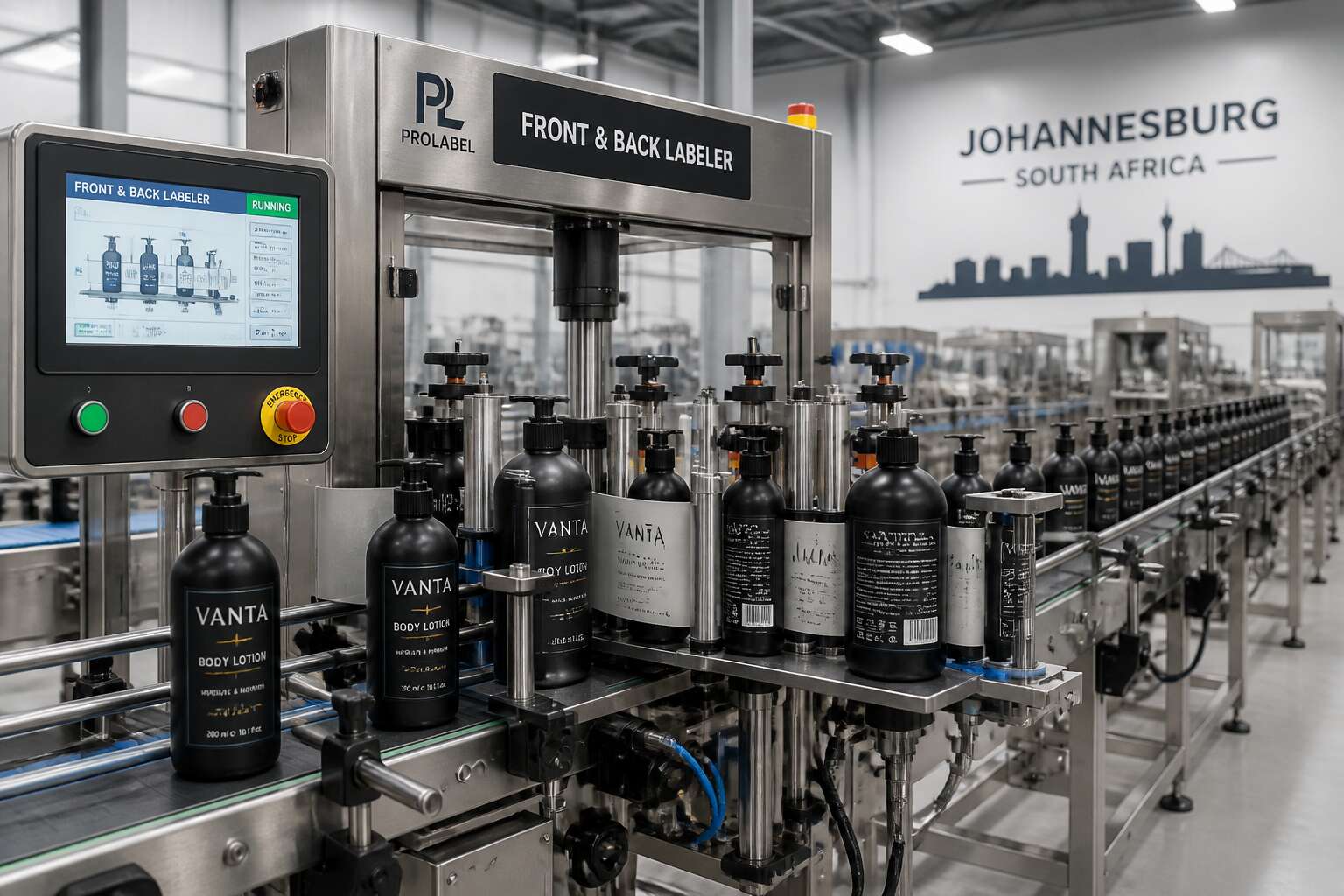
A misapplied label costs more than a minute of lost output. It can stall an entire packaging shift. That is why a front and back labeling machine johannesburg has become common on modern production lines. This equipment places labels on two opposite faces of a container in a single pass, removing a separate manual step.
Let me walk you through the mechanics. A conveyor moves the product toward a front labeling head. Once that label is fixed, the container advances to a second station that handles the rear panel. The machine syncs speeds and sensors so the two labels align correctly, regardless of bottle shape.
Operators typically look for these features in a front and back labeling machine johannesburg:
– Servo driven label heads for precise placement
– Quick changeover tooling for different container sizes
– Rejection systems that remove mislabeled units
The result is a clean, consistent finish on every unit passing down the line.
How Dual-Side Labeling Improves Production Efficiency
Downtime is often the quiet enemy of a production line, and label misalignment is one of its most common triggers. A front and back labeling machine johannesburg solves this by applying both labels while the product is still in motion, moving from one applicator to the next without a pause. The precision comes from a system that reads the container’s position at every stage, which makes the process feel almost orchestrated.
The most efficient dual side units use independent servo drives for each labeling head. This allows one operator to adjust timing on the fly, without stopping the entire conveyor.
– The right hand head applies the front label.
– The left hand head follows milliseconds later.
– A sensor verifies placement before the bottle reaches the next station.
This continuous flow reduces the floor space needed for packaging lines. It also removes the risk of manual reorientation errors, which often appear during changeovers. For facilities processing beverages, cosmetics, or pharmaceuticals, this technology directly addresses the bottleneck of secondary handling.
Key Components of Modern Labeling Systems
In the quiet hum of a Johannesburg bottling floor, precision is not a luxury; it is a contract. Understanding the anatomy of a front and back labeling machine johannesburg begins with the applicator heads. These units rely on servo motors and vacuum drums to hold each film label taut, while a photoelectric sensor reads the container’s contour. The controller orchestrates the sequence, calculating speed and pitch without hesitation.
The frame itself matters. Stainless steel cabins protect the electronics from caustic washdowns. A touchscreen interface translates complex timing adjustments into simple commands.
Consider what drives the system:
- Servo driven applicators for repeatable placement.
- A registration mark sensor for print position.
- A conveyor speed encoder to synchronize with the line.
These components work in silence, but they define the rhythm of production.
Common Industries Using This Equipment
In Johannesburg’s beverage and pharmaceutical corridors, the front and back labeling machine johannesburg relies on a matrix of stepper motors and camera-guided registration. These systems measure the gap between label edge and bottle seam within fractions of a millimetre. Rather than pressing labels blindly, the applicator adjusts its blow-on or wipe-on motion based on live sensor feedback.
Industries that demand this precision:
– Cosmetic manufacturers with oval or tapered packaging
– Chemical producers requiring tamper-evident wrap-around placement
– Agri-processing plants handling irregular glass jars
Dairy, personal care, and craft beverage operations in Gauteng deploy dual-side systems to avoid secondary handling. A front and back labeling machine johannesburg that combines pressure-sensitive reels with hot-melt adhesive stations gives producers the flexibility to switch between PET, glass, and metal substrates without reordering tooling.
Benefits of Upgrading to a Dual-Side Labeling Machine in Johannesburg
Faster Throughput for Local Manufacturers
In Johannesburg’s bustling industrial corridors, time is the most unforgiving currency. For a manufacturer, every halted production line translates directly into lost revenue. This is where the shift to automated precision changes the game entirely. Upgrading to a modern front and back labeling machine johannesburg operations rely on offers a tangible leap in speed that manual processes simply cannot match.
The mechanics of a dual side system allow products to be processed in a single, continuous pass. Instead of laborious repositioning, containers move through the line with a fluid rhythm. This consolidation cuts handling time dramatically, allowing you to push more units out the door before the end of shift. For local producers facing tight deadlines, this bottleneck removal is the difference between profit and pressure.
Beyond the sheer velocity, the consistency of automation reduces costly downtime. Operators are freed from repetitive tasks to manage quality control elsewhere on the floor. When the machinery works in concert, the output becomes predictable, which is essential for accurate planning.
– Reduces changeover time between different bottle sizes.
– Minimizes the risk of product damage from excessive handling.
– Allows staff to focus on line monitoring, not manual placement.
Ultimately, investing in this technology is a direct response to the demands of a competitive market. The pace of business moves quickly, and your equipment should keep stride with your ambition.
Reduced Labor Costs and Human Error
In Johannesburg, labor costs consume nearly a third of operational budgets for many packaging lines. Upgrading to a front and back labeling machine johannesburg manufacturers use eliminates the need for two or more staff members at manual labeling stations. That shift alone can slash annual payroll expenses by R250,000 or more! Human error also disappears. Misapplied labels, crooked placements, and missed batches become rare exceptions.
- Rejected products that eat into profit margins.
- Rework hours spent fixing off-center labels.
- Supervisory time lost to inspection and correction.
In our experience, automated dual-side systems reduce these variables to near zero. The machine applies labels with consistent tension and placement on every cycle. Your quality team can pivot to auditing raw materials or fine-tuning production schedules. The bottom line shifts from constant correction to steady, predictable output.
Enhanced Compliance with South African Label Regulations
South African labeling regulations are unforgiving. The Consumer Protection Act demands clear, accurate information on every product that crosses a store shelf. For manufacturers in Johannesburg, a single misaligned barcode or missing ingredient declaration can trigger expensive product recalls and regulatory penalties. A front and back labeling machine johannesburg enables this precision by applying labels to both panels simultaneously, ensuring each unit meets the exact legal formatting standards.
Consider how specific compliance requirements become simpler to manage:
- Mandatory front panel information like product name and net content stays within regulated zones.
- Back panel details such as manufacturer address, batch codes, and storage instructions remain legible and correctly positioned.
This dual-sided approach removes the guesswork from legal compliance. You gain confidence that every batch leaves the line ready for the South African market.
Space-Saving and Flexible Integration
Consider the floor plan of your current production facility. A front and back labeling machine johannesburg can reclaim precious square meters by replacing two separate units with one streamlined system. This compact footprint allows for better movement of personnel and materials around the line.
The horizontal integration of the dual-side unit eliminates the need for additional conveyors and transfer stations. You can place the equipment directly into existing layouts without a major overhaul of your infrastructure. This flexibility proves valuable for growing operations.
– Reduced conveyor length minimizes the risk of product jams.
– Simplified changeover procedures require less floor space for tooling storage.
– A unified control panel means fewer electrical connection points.
The machine’s adjustable infeed and discharge sections allow for precise positioning against current machinery. This adaptability ensures a synchronized output flow, which keeps your production rhythm steady. You maintain a tidy workspace while achieving the accuracy of a front and back labeling machine johannesburg.
Cost-Benefit Analysis for Small and Medium Enterprises
In the world of manufacturing, capital expenditure is a scary word. But operational expenditure is a scarier one. The real question for a small or medium enterprise in Johannesburg isn’t just the sticker price of a new machine, it is the monthly bleed of inefficiency. Upgrading to a front and back labeling machine johannesburg operations can trust often looks like a luxury until you calculate the true cost of running two separate, slower units. You are paying for the floor space, the extra electricity, and the salaries of two operators when one could easily handle the workload.
The math becomes even more compelling when you factor in the cost of rejected products. A dual-side unit applies labels with a precision that manual or semi-automatic processes simply cannot match. Every mislabeled jar or skewed bottle that goes out the door is a direct hit to your bottom line, especially if you lose a retail contract because of compliance issues. The financial benefit of upgrading is often measured in the reduction of that waste alone. For an SME, the savings are not just a line item, they are the difference between surviving the month and thriving in it.
Let’s look at the tangible operational cost reductions that a single unit offers over a dual-machine setup:
1. Lower energy consumption per unit produced.
2. Reduced maintenance contracts, since you only service one motor system.
3. Fewer spare parts to keep in stock for changeovers.
4. A smaller footprint that lowers your rental overhead if you are leasing space.
The flexibility of this equipment is the secret weapon for SMEs who need to pivot quickly. If a major retailer in Johannesburg suddenly asks for a new label design or a different bottle size, your line needs to adapt without grinding to a halt. A front and back labeling machine johannesburg suppliers offer allows you to switch between product runs in minutes rather than hours. This agility means you can accept smaller, more profitable custom orders without disrupting your main production schedule. You are not locking yourself into a rigid system; you are buying the ability to say yes to new business opportunities.
Ultimately, the decision comes down to the return on investment timeline. Many local businesses are surprised to find that the increase in throughput and the decrease in labor costs pay for the machine within a year. The controlled investment in a single, high-quality unit is often far less daunting than the cumulative costs of maintaining older, outdated machinery. It is a strategic move that aligns your production capacity with the demands of the market. The finance department will appreciate the logic, and the production floor will appreciate the efficiency. It is an upgrade that pays for itself while you sleep.
Selecting the Right Machine for Your Production Line
Assessing Label Size and Bottle Shape Requirements
Every bottle presents a unique physical challenge. The label adheres, stretches, or wrinkles based on your container’s curvature. For a front and back labeling machine Johannesburg to perform reliably, you must measure label width, height, and material flexibility. Identify whether your bottles are cylindrical, elliptical, or flat-sided. These dimensions dictate the applicator heads and pressure systems required.
Consider these factors:
- Label panel contour and surface texture
- Bottle taper and neck-to-body ratio
- Changeover speed between product runs
Matching these physical attributes ensures each label wraps and settles correctly.
Speed, Automation Level, and Changeover Time
Most production managers in Johannesburg focus on maximum speed when evaluating equipment. Yet the pace of your line means little if the changeover to a new product takes so long that you lose the advantage elsewhere. A front and back labeling machine johannesburg based suppliers sell can run at high speeds, but the true measure of profitability is the total time from one finished batch to the next, running smoothly at full capacity.
The decision you face is not about raw throughput alone. It is about matching machinery cycles to your current order volume and your growth targets. A smaller contract packaging firm may need slower operations with frequent format swaps. A large beverage manufacturer may run the same bottle for months. These two customers need different machinery and different budgets. Your production schedule defines the baseline for speed requirements, not an arbitrary technical specification.
Automation level shapes the same choice. A basic machine with manual adjustments consumes labor time every time a bottle size changes. The operator must loosen bolts, shift rails, adjust sensors, and reset torque values. This rote process raises the chance of error with every shift change. Investing in servo driven systems lets operators recalibrate through a touchscreen interface. The machine stores your previous settings and recalls them in moments upon request.
For high volume bottling lines, shift your evaluation toward these factors:
– Servo driven label heads for precise registration at speed
– Tool-less changeover components to reduce downtime
– Label reel splicing to handle roll changes while running
– Memory retention for hundreds of product recipes
Changeover time is the quiet killer of production schedules. A machine that labels 150 bottles per minute but needs a 45 minute format change slows down in practice. A slower machine that never runs without printed labeling in quick order beats it. Any front and back labeling machine johannesburg distributor can quote the maximum speed. Ask about the minimum time between product runs. That number determines your real output. Demand for production days of your recent bottle sizes and shape designs from prospective vendors.
Compatibility with Existing Conveyor Systems
Your conveyor system sets the pace for everything downstream. A labeling machine that cannot match its height, speed, or bottle spacing creates backups no matter how fast it cycles. A front and back labeling machine johannesburg suppliers install must align with your existing conveyor elevation and motor controls.
Compatibility goes beyond physical fit. I have watched production lines bottleneck at the labeling station simply because the machine ignored the conveyor’s rhythm. The details that matter:
- Sensor synchronization with your current PLC system
- Bottle spacing tolerance across variable speeds
- Infeed and outfeed adjustment ranges
Most Johannesburg factories run custom conveyors built in local workshops. Exact dimensions matter when requesting quotes. Standard specifications rarely match the installed reality.
Supplier Support and After-Sales Service in Gauteng
The real cost of any front and back labeling machine johannesburg factory chooses appears only after installation. Gauteng’s industrial environment demands suppliers who answer the phone when a shift supervisor reports a misfeed at 7 a.m. A supplier without local stock of wear parts or a qualified technician can idle your line for days. I have seen companies buy cheaper imported units, then pay double in downtime.
Ask every potential supplier for their service response time in writing. Request documentation of their spare parts inventory. Verify that they offer training for your operators, not just a quick handover. The practical support structure matters more than the brochure promises.
- Response within 8 hours for breakdowns
- On-site repair capability, not phone support
- Stock of replacement belts, sensors, and glue units
These criteria separate reliable suppliers from mere resellers. When your line stops, proximity to a Johannesburg-based technician and a ready parts bin become the only numbers that matter.
Budgeting and Return on Investment
If a supplier quotes a price that sounds suspiciously low, your wallet should flinch. The cheapest front and back labeling machine johannesburg you can find will likely swallow the savings through maintenance calls. Budget for the total cost of ownership, not the initial invoice.
Work out your return on investment using downtime, rejected labels, and operator hours. A pricier machine that runs reliably for twelve years beats a bargain that limps to failure in three.
- Track the cost per label produced, not the machine price.
- Factor in glue cleanup and the value of rejected bottles.
- Compare financing options against the wages of a manual labeling crew.
Remember that the label is the only part of the product your customer actually touches. A front and back labeling machine johannesburg plant chooses must justify itself through consistent output. Include the cost of an operator staring at a jammed conveyor at 9 p.m. on a Friday and your spreadsheet suddenly becomes honest.
Installation and Maintenance Best Practices
Preparing Your Facility for Installation
Preparing your facility for a front and back labeling machine johannesburg installation requires more than clearing a corner. A detailed site audit prevents costly delays. Check floor flatness, since uneven surfaces misalign conveyors. Verify electrical capacity, especially voltage stability. Pneumatic systems demand clean, dry air.
Here are some essential steps:
- Measure clearance around the machine for maintenance access.
- Confirm compressed air supply meets the manufacturer’s specifications.
Additionally, plan for material flow. Incoming containers and finished goods need buffer zones. Without these, the labeling machine becomes a bottleneck. Schedule installation during low production periods to minimize disruption.
Training Operators and Maintenance Staff
According to industry data, over 70% of labeling line stoppages trace back to operator error or inadequate maintenance routines. That number becomes critical when you rely on a single front and back labeling machine johannesburg facility to meet production targets. Training cannot be a one-time demonstration. It must be a living process!
Operators need hands-on practice with changeover procedures and sensor calibration. Maintenance staff require a detailed understanding of servo drives and pneumatic actuators. Create a structured skill matrix to track competency.
- Daily cleaning of glue or adhesive residue
- Weekly inspection of drive belts and timing sensors
- Monthly verification of air filter moisture levels
Pair this with a predictive maintenance schedule that monitors wear patterns on actuator seals. A front and back labeling machine johannesburg operates best when its operators understand failure modes, not just button functions. Shift handover logs should capture anomalies. This attention to detail separates smooth operations from recurring downtime.
Routine Cleaning and Calibration Schedules
Routine cleaning sounds boring until you watch a glue hardened sensor send a label spiraling into a reject bin. A front and back labeling machine johannesburg needs its rollers wiped every shift. Adhesive residue is the enemy. Calibration is the real discipline. For routine cleaning, follow a simple roster:
- Wipe adhesive residue from rollers and guides each shift.
- Check timing sensors for glue haze every Monday.
- Verify air filter moisture levels on the first of each month.
Sensors drift with temperature swings in Gauteng factories. Adjust them weekly, not quarterly. Optical checks of label overlap prevent misalignment. That is where most local lines fail.
Troubleshooting Common Labeling Issues
When the installation crew leaves, the real test begins. A front and back labeling machine johannesburg demands a level base and a dry air supply. Many factories overlook the compressor’s moisture trap, which then spits water into the pneumatic cylinders. That causes erratic label placement that mimics a sensor fault.
Troubleshooting common issues requires a systematic eye. If the machine jams at the same spot every cycle, suspect the changeover parts rather than the logic controller. For intermittent issues, watch the machine through a full cycle without touching anything. The answer often appears as a worn gripper bar or a tangled ribbon.
Cable management matters more than people assume. Run control wiring away from the motor leads, or electromagnetic interference will cause phantom faults. Check the earth bond on the main cabinet first, as loose grounds mimic every fault imaginable.
Partnering with Local Technicians in Johannesburg
The value of a front and back labeling machine johannesburg depends on how quickly your team can respond when something drifts out of specification. A local technician who knows this equipment can shorten response times from days to hours, especially when production lines run multiple shifts across Gauteng industrial zones.
Consider what a trusted partnership should provide:
– Scheduled visits that catch wear before it becomes a breakdown
– Calibration checks using local water quality readings
– Direct access to spare parts held in Johannesburg warehouses
These services matter because a labeling line is only as reliable as the support around it. Your operators might handle routine adjustments, but a qualified technician brings diagnostic tools and manufacturer training that in-house staff rarely possess. Building this relationship before a crisis occurs ensures the front and back labeling machine johannesburg stays productive when you need it most.
Future Trends in Labeling Technology and Local Market Outlook
Smart Labeling and Data Integration
As Johannesburg’s production floors evolve, the future of labeling is defined by data as much as by adhesive. The front and back labeling machine johannesburg now prepares for a role beyond film application, becoming a fixed node in the factory’s information flow.
Smart labeling links each bottle to its digital record, capturing batch numbers, expiry dates, and production variables in real time. Data integration lets operators see faults before they compound. The local market outlook confirms this direction. Gauteng producers are comparing machines on their ability to connect with enterprise systems, not just on speed. Emerging trends include:
- Cloud-hosted production dashboards
- IoT sensors that flag misalignment mid-run
- Automated quality documentation for audits
The front and back labeling machine johannesburg, once selected by output alone, is now chosen for how well it integrates with plant infrastructure. We see this shift daily in our work with local manufacturers.
Sustainable Materials and Eco-Friendly Options
Around 40% of label waste in Gauteng ends up in landfill, forcing producers to rethink film choices. The front and back labeling machine johannesburg now faces a new demand: handle thinner, compostable substrates without losing registration accuracy.
Recycled PET and polypropylene films have different coefficients of friction and heat tolerance. Water based adhesives, once slow to cure, now rival solvent options in tack and strength. A labeling line must accommodate these variables or risk mislabeled outputs.
Municipal waste regulations are tightening, and retailers press suppliers for recyclable packaging declarations. In our work with Gauteng producers, this shift is unmistakable! The front and back labeling machine johannesburg that runs eco-friendly stock without excessive waste will hold resale value longer. Sustainability is now a baseline requirement in tender documents across Gauteng.
Modular Machines for Greater Versatility
As the label market in Johannesburg matures, the focus shifts to adaptability. Operators are realizing that a dedicated line for a single bottle shape is a liability, not an asset. The emerging reply is modular architecture. These systems allow for the fast exchange of labelling stations and conveyor widths. This flexibility matters because product runs are shrinking. A producer might run 5,000 units of a craft beverage, then switch to a pharmaceutical vial before lunch. The front and back labeling machine johannesburg must change over in minutes, not hours.
This shift impacts the engineering of the machines themselves. Sensors and applicator heads are now mounted on tool-less adjustment rails. Programmable logic controllers store dozens of job recipes. Operators recall settings for pressure, glue temperature, and label feed speed with a touch of the screen. This reduces downtime and eliminates the need for specialized setup skills on the factory floor.
– Automated size recognition reduces manual input errors.
– Servo driven motors provide precise placement at varying speeds.
– Retrofit kits allow older machines to gain new capabilities without full replacement.
For the local market outlook, this is a significant development. Gauteng businesses face pressure from labor costs and import competition. A modular unit, while a higher initial investment, provides a hedge against shifting consumer trends. The secondary market for these machines is also stronger. A used front and back labeling machine johannesburg retains its value better when it can handle a wider range of jobs. Buyers are now looking for versatility as a primary feature, not just speed or raw output. This focus on future-proofing is driving purchasing decisions across the region.
Johannesburg’s Growing Demand for Packaging Automation
Johannesburg’s packaging sector is shifting toward intelligent systems that anticipate production needs before a single glass bottle touches the conveyor. The future of the front and back labeling machine johannesburg lies in cognitive integration, where every applicator head operates as a node within a wider factory network. Real-time data feedback allows operators to monitor label adhesion torque and adhesive cure rates mid-run, detecting anomalies that would previously have gone unnoticed until quality control rejected an entire pallet. This level of foresight transforms labeling from a reactive process into a predictive one, and it is this capability that local beverage producers are beginning to demand.
Automation in Gauteng is no longer simply about replacing manual labor with robotic arms. The conversation has shifted toward harmonizing machine intelligence with human oversight. A modern front and back labeling machine johannesburg now generates its own maintenance alerts and diagnostic logs, reducing the cognitive load on floor staff. Consider the practical implications for a craft distillery in Cullinan or a cosmetics manufacturer in Midrand. They need equipment that communicates with their broader production planning software, adjusting label feed rates autonomously when a batch of oddly shaped bottles arrives. This synergy between the physical machine and the digital ecosystem is the hallmark of the next generation of labeling equipment.
The local market is also seeing a growing preference for units that accommodate multiple label materials without requiring extensive reconfiguration. Producers are experimenting with polymer films, recycled papers, and even fabric-based labels for premium lines. The front and back labeling machine johannesburg must therefore handle varying surface textures and adhesive viscosities with equal finesse. Buying decisions now hinge on a machine’s ability to adapt to these emerging materials, not just its current output capacity. Suppliers who offer on-site training for such advanced features are gaining a distinct edge over those who simply deliver the hardware and walk away.
Demand for packaging automation in Johannesburg continues to climb, driven by a need for consistency that manual lines simply cannot offer at scale. The numbers reflect this urgency, with local packaging machinery imports rising steadily each fiscal year. A dual-side labeler that can run 12,000 units per hour, while printing variable data like batch codes and QR encryption directly onto the label surface, is becoming a standard expectation. For small to medium enterprises, this level of automation was once a distant prospect, but modular pricing models have made it attainable.
- Automated adhesive temperature compensation for high-altitude factory floors.
- Self-optimizing label feed mechanisms that adjust to paper curl variations.
- Remote diagnostic access for Johannesburg-based service technicians to troubleshoot without site visits.
The practical result for businesses in Gauteng is a shorter path from raw bottle to packed crate. Fewer manual interventions also mean a lower probability of misalignment or smudged graphics. When a labeling line runs with near-silent precision, operators can devote their attention to the nuanced tasks that still require human judgement. The quiet hum of a well-integrated labeling system, churning out perfectly placed front and back panels hour after hour, is becoming the defining sound of modern beverage production in South Africa. The trajectory is unmistakable, and the local market is responding with decisive investment.
Choosing a Future-Ready Machine
Johannesburg’s labeling landscape is quietly preparing for a shift toward predictive maintenance and data-driven decision making. The front and back labeling machine johannesburg of tomorrow will not simply apply labels, it will communicate its own performance metrics to off-site technicians before a minor misalignment becomes a costly stoppage. Local suppliers are responding to this demand by stocking units with open protocol interfaces that speak directly to existing factory management platforms.
The market outlook is defined by purchasers who look beyond current throughput figures. They evaluate a machine’s capacity for future firmware upgrades, remote calibration, and compatibility with evolving label adhesives.
- Modular servo drives that allow incremental speed upgrades without full machine replacement
- Integrated camera systems that verify label placement accuracy in real time
- Cloud connected diagnostics for proactive servicing from Johannesburg based engineers
Choosing a future-ready front and back labeling machine johannesburg means prioritising adaptable software architecture over raw hardware specifications. The local market is moving toward systems that can learn from each production cycle, refining application pressure and registration with every run of bottles. Producers who treat this purchase as a long term technological partnership rather than a one off equipment buy are positioning themselves for the next decade of packaging evolution in Gauteng.

0 Comments